Sub oscillator & noise
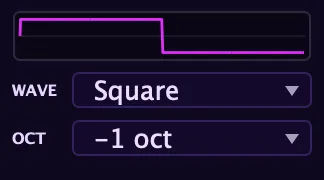
Under the three main oscillators sit a sub oscillator (with its own wave and octave for adding weight below the fundamental) and a noise source offering several flavors, including tuned noise and a sample-and-hold source.
Sub oscillator
Section titled “Sub oscillator”The sub tracks the pitch you play and adds content at a fixed octave below. It is the simplest, most direct way to add low-end weight to any patch without touching the main oscillators. Its level sits alongside the other sources in the Mixer.
Three shapes are available:
-
Sine: a clean, round fundamental with no harmonics. Adds pure low-end mass without any brightness whatsoever. The right choice when you want weight that does not interfere with the mid-range character of the main oscillators.
-
Triangle: slightly warmer than a sine with a trace of upper harmonics, but still smooth and unobtrusive. A good middle ground when you want the sub to be slightly more “present” without becoming a distinct voice.
-
Square: the loudest and most harmonically active of the three. Adds not just the sub octave but its odd harmonics (third, fifth…), which can make the low end feel woolly or powerful depending on the patch. Useful when you specifically want the sub to contribute to the mid-range body, not just the bass.
Octave
Section titled “Octave”Octave switches the sub between one octave below (−1) and two octaves below (−2) the played note. At −2, in the lower keyboard registers, the sub reaches very low frequencies; make sure your monitoring can reproduce them, and watch the Mix Drive if you push the sub level high, as the low energy will drive the pre-filter stage hard.

Aconite’s noise source is not a single colour but a menu of seven distinct flavours. Each one has a different spectral balance, and some have their own controls that appear when selected. Noise level lives alongside the other sources in the Mixer.
Spectral colours
Section titled “Spectral colours”White: equal energy at every frequency. Full, present, and balanced from low to high. The classic starting point for wind, breath, and percussion noise.
Pink: energy falls off at 3 dB per octave as frequency rises, which matches the sensitivity curve of human hearing closely. Pink noise sounds perceptually balanced, neither too thin nor too low-heavy. Good for natural breath, air, and ambience textures.
Red / Brown: energy falls off more steeply, concentrating power in the bass and low-mid. A deep, rumbling texture that can underpin bass sounds or provide a sub-conscious low-end presence.
Blue: energy rises with frequency, the opposite of pink. Brighter and more hissing than white. Useful for air, high-end sheen, or textural brightness when you need noise that cuts through.
Violet: even more high-frequency emphasis than blue. Very bright, close to a hiss or a spray. Useful in small amounts for high-end texture or layered into bright percussive transients.
Tuned noise
Section titled “Tuned noise”Tuned is a band-pass-filtered noise source with three controls:
- Tune: the centre frequency of the band-pass filter, from low rumble to high hiss. The noise only passes frequencies near this centre.
- Reso: the resonance (Q) of the band-pass filter, from a wide, gentle band to a very narrow resonant peak. High resonance makes Tuned noise sound almost pitched: a useful bridge between noise and tone.
- Keytrack: when turned up, the Tune centre follows the played note pitch. With high Reso and Keytrack, Tuned noise becomes an almost-pitched voice that rises and falls with the keyboard, useful for breath, reed simulation, or atmospheric pitched textures.
Sample & Hold
Section titled “Sample & Hold”Sample & Hold is a stepped noise source: the classic S&H generator of modular synthesis, here used as an audio-rate noise flavour rather than a modulation source. It produces a random staircase of values:
- Rate: how fast the random value changes. At slow rates you get a coarse, chunky, almost melodic randomness; at fast rates it approaches a rougher, buzzing texture closer to digital noise.
- An interpolation control smooths (or leaves stepped) the transitions between values. Left unsmoothed, the steps are hard and bright; smoothed, the texture blurs into something closer to filtered noise with a characteristic undulation.
Sample & Hold noise fed into the filter, especially with some resonance, can produce robotic, glitchy, and random-pitched textures that none of the spectral colours reach.
Noise through the filter
Section titled “Noise through the filter”All noise flavours run through the filter exactly like the oscillators do. This means the noise is shaped by Cutoff and Resonance, responds to filter envelopes, and can be filtered down to a narrow band. Turning up Resonance with white or pink noise is one of the fastest routes to a wind or breath whoosh: the resonant peak sweeps through the noise as you move Cutoff, giving the noise a pitched, wind-chime quality.
You can also route noise into the modulation matrix as a source to modulate other parameters directly, which is separate from using it here as an audio source in the mixer.