The two filters
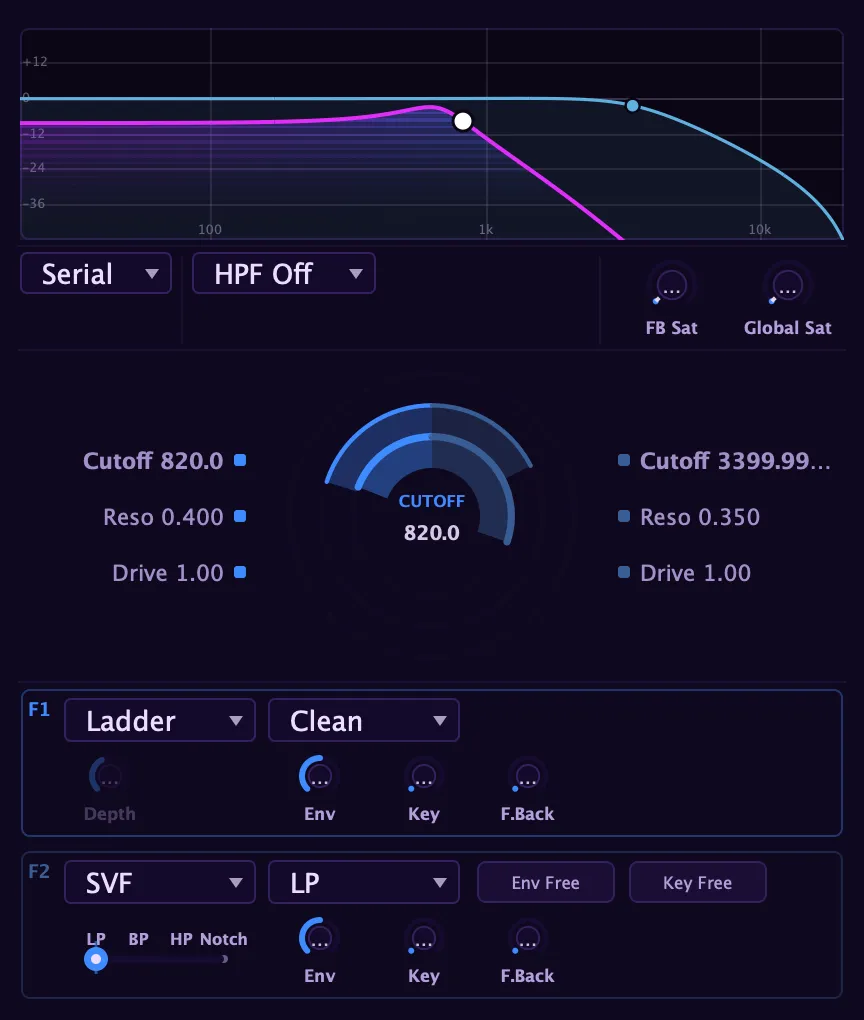
The filter block is the heart of Aconite’s character. Each of its two independent filters offers seven models (Ladder, SVF, Bite, Multimode, Cascade, Diode, and Acid) with Cutoff, Resonance, and Drive, a discrete Mode plus a continuous, modulatable Morph, key-tracking, envelope amount, and the Voicing (Clean / Analog) and Depth character controls. These controls interact in deliberate ways worth learning; that interaction is what makes the section reward exploration.
The seven models
Section titled “The seven models”Every model is available on both filters, and each one has its own heritage and its own sonic personality. Choosing a model shapes not just tone but behavior: how resonance blooms, how Drive bites, and how hard the filter pushes back.
Ladder
Section titled “Ladder”The classic 4-pole low-pass, in the lineage of the synthesizers that defined what a filter could be. A saturator lives inside the resonance loop, so as you push Resonance, instead of blowing up into a harsh spike, the peak compresses into a warm, characteristic growl. Near maximum Resonance the filter approaches self-oscillation. Rich, vintage, weighty, the obvious choice for basses, leads, and anything that needs “that” sound.
A clean, versatile state-variable filter producing low-pass, band-pass, high-pass, and notch responses. It is the lightest model on CPU and the right choice when you need clarity: bright pads, high-polyphony patches, or a foundation you can build character onto with Drive and Feedback. A light input drive adds gentle warmth when you push it, but it never becomes aggressive.
An aggressive Sallen-Key design in the MS-20 lineage. Its feedback saturator lets the resonance scream and grow before a gentle limiter keeps it musical, and it will fully self-oscillate at maximum Resonance. This is the model to reach for when you want something forward, gnarly, and slightly unpredictable: sharp leads, harsh sweeps, grit-forward sound design.
Multimode
Section titled “Multimode”A Roland-style tapped 4-pole ladder that produces low-pass, band-pass, high-pass, and notch responses from a single structure, plus an intermediate LP2 slope. Drive saturates the input only, keeping all the filter responses clean and well-defined even under heavy gain. A very useful model when you want multi-response capability without sacrificing tonal clarity.
Cascade
Section titled “Cascade”A cleaner Moog cascade with a continuous Drive range that sweeps from Clean (exactly linear, no coloration) through to Rough (tames resonance as it distorts). Clean mode is ideal for pads and strings that need air without grit. Cascade also offers a slope switch between 12 dB/oct and 24 dB/oct: use 12 for more open, airy sounds; 24 for thick, closed-down character.
Modeled in the diode-ladder tradition, with a gentler frequency knee than the Ladder and a singing resonance that peaks slightly sharp of the cutoff frequency, a quirk of the inter-stage diode coupling that gives it an airy, elastic quality. The passband stays full as Resonance rises, so it never sounds thin. Think of this as the neutral acid flavor: present and musical without being imposing.
A strict acid-lineage filter with four poles and spread poles for a gentler knee. Its resonance sits right on the edge of oscillation, and an internal feedback high-pass emphasizes the characteristic squelch cut (a circuit-level detail distinct from the front-end HPF) that gives Acid its unique midrange scream. The uncompensated passband means resonance literally eats the low end, a feature. The tuning-stable peak stays locked as you modulate. When you need the 303-style squelch, start here.
Mode and Morph
Section titled “Mode and Morph”Three models (SVF, Bite, and Multimode) go further than just switching between responses: they produce a continuous blend between them.
- SVF and Bite morph across LP · BP · HP · Notch.
- Multimode morphs across LP4 · LP2 · BP · HP · Notch: that extra LP2 tap gives it a distinct in-between slope not available on the other morphable models.
The Mode selector snaps to a discrete response. The Morph control is a signed offset from that position that blends continuously between the adjacent modes. Rather than clicking between responses, you can sweep through them smoothly, or, more powerfully, route a modulation source to Morph 1 or Morph 2 in the modulation matrix and let an LFO or envelope carry the filter from low-pass through band-pass into high-pass inside a single patch.
The Ladder, Cascade, Diode, and Acid models are fixed-mode: they ignore Morph, since their character comes from the specific behavior of one response, not a blend.
Cutoff, key-tracking, and envelope amount
Section titled “Cutoff, key-tracking, and envelope amount”Cutoff sets the filter’s corner frequency across the full audible range. It responds to several modulation inputs at once (the filter envelope, LFOs, key-tracking, the Step Sequencer, the Performer, and anything else you route through the modulation matrix all sum onto it), so a single knob position is really a base value that modulation rides on top of. A small per-voice drift also nudges each voice’s cutoff slightly from its neighbors, giving the filter block an organic, analog aliveness even on sustained chords.
Key Track ties the cutoff to the note you’re playing: at 100%, the filter tracks exactly one octave per octave, keeping timbre consistent as you move up the keyboard. At 0% the filter stays fixed. Values in between give a softer tracking that is natural for many pads and leads.
Env Amt (envelope amount) scales how far the filter envelope pushes cutoff from its resting position on each note, over a range of ±6 octaves. A positive value opens the filter on attack; a negative value closes it. The amount is also scaled by velocity, so playing harder produces a more dramatic sweep without any extra routing. Pair with Decay and Sustain to create plucks, stabs, and evolving filter sweeps. Both Env Amt and Key Track can be linked to Filter 1 when Filter 2 is running independently, or kept separate. See Routing & configs.
Resonance and Drive
Section titled “Resonance and Drive”Resonance sets the Q, the emphasis at the cutoff frequency. Every model approaches self-oscillation near maximum, bounded so it stays musical rather than blowing up. The exact character of that peak varies by model: sharp and squelchy on SVF, compressed and growly on Ladder, on-the-edge on Acid.
Drive is input gain into the filter’s nonlinearity, and what “Drive” means is model-specific:
- On Ladder, Bite, Diode, and Acid: pre-gain into the in-loop saturator, adding harmonic saturation and compressing the resonance peak under heavy gain.
- On Multimode: input saturation only, keeping the filter responses clean.
- On Cascade: the blend between Clean (linear) and Rough (tames resonance as it distorts).
- On SVF: a light input soft-drive for gentle warmth.
Both Resonance and Drive are modulation matrix destinations.
Voicing and Depth
Section titled “Voicing and Depth”Voicing and Depth are available on the Ladder and Diode models (and apply to both when you’re running them together), acting inside the filter’s saturation character, a good example of the kind of control that sounds redundant until you hear it.
Voicing switches between Clean and Analog internal saturation paths. Despite the names, Clean is the screamier option: it has a taller, sharper, more squelchy resonance, because its low-distortion path lets the peak ring freely. Analog compresses and tames the resonance the way real hardware does, adding body and grit as you push Drive. Think of Voicing as a resonance-character control first, and a distortion-character control second.
Depth sets the amount of the Analog path’s internal clipping. Under Clean voicing it does nothing. Under Analog, turning Depth up increases the grit and compression, useful for matching the feel of particular hardware or finding a middle ground between singing and saturated.
Both filters carry their own Voicing, Drive, and Depth, so you can pair a screaming Clean Filter 1 against a composed Analog Filter 2, or any other combination that suits the sound you are after.
Global Sat
Section titled “Global Sat”Global Sat is a soft-clip on the voice output (always audible, always active) whose knob sits on the filter panel next to FB Sat. Where FB Sat only works when a filter Feedback loop is engaged, Global Sat adds gentle warmth to the voice regardless of patch or filter model. Use it to take the slight digital edge off an otherwise clean voice, or to give a whole patch the kind of rounded, consistent character that makes a polyphonic stack feel cohesive. It is a whole-voice control, not a per-filter one: every oscillator, model, and routing choice you make still passes through it on the way out.
How the controls interact
Section titled “How the controls interact”These are the behaviors worth knowing before you start exploring:
- Clean voicing is the screamier one. It has the sharper, more squelchy peak. Analog tames it. If resonance sounds too polite, try Clean.
- Feedback and Resonance are antagonistic at high Q. Cranking Feedback while Resonance is high does not add more scream; it collapses the sharp peak into a broader growl below cutoff. Feedback is a “growl / tame the scream” color, not extra resonance. See Feedback & FB Sat for the full picture.
- Depth only acts under Analog voicing. Under Clean, it is silent.
- Morph does nothing on fixed-mode models. Save it for SVF, Bite, and Multimode.
- Global Sat is always audible; FB Sat is not. If you want whole-voice warmth regardless of patch, reach for Global Sat. FB Sat only colors the feedback loops; with Feedback at zero it has nothing to act on.
The filter section is designed to reward that kind of systematic exploration. Each control acts at a different physical point in the signal path, and understanding where is the depth that turns the section from “many knobs” into a coherent instrument.