Oscillators
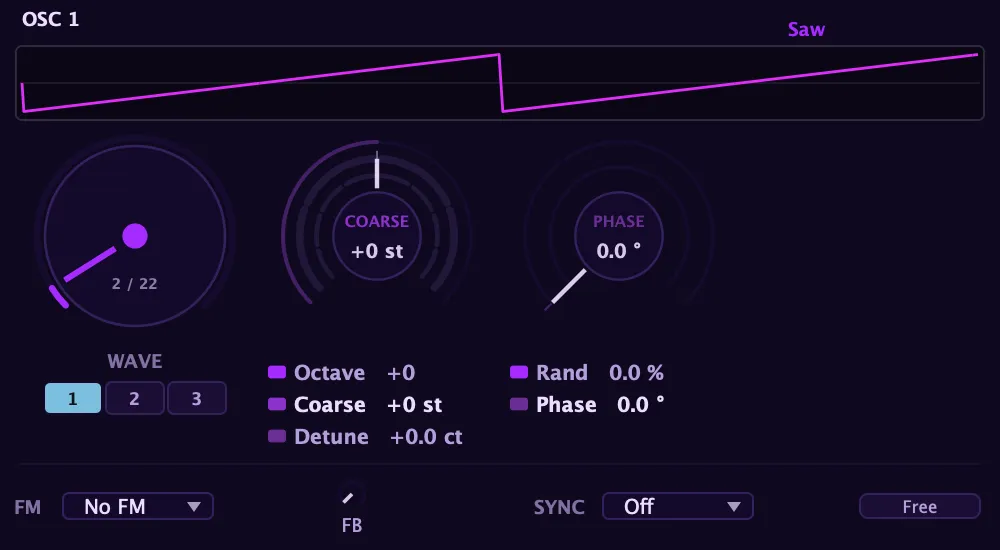
Aconite gives you three full oscillators, each built on a Wave × Model idea: you pick a waveform and, independently, a model that decides how that waveform is generated. The models span classic analog and virtual-analog, a DCO, wavetable, the additive bank, the modeled Acoustic concert grand, the physical-modeling String, Modal, and Kick voices, and the authentic Chip oscillator (NES 2A03 and C64 SID). Each oscillator has its own octave, coarse tune, detune, pulse width and PWM, and phase controls.
The three oscillators share one panel
Section titled “The three oscillators share one panel”You edit all three oscillators through a single panel, switched by the 1 / 2 / 3 selector in the panel header. Click 1, 2, or 3 and the panel shows that oscillator’s controls; whatever you change applies only to the oscillator you have selected. This is how you reach oscillators 2 and 3: there is no second or third panel to find, just click the number.
Each oscillator keeps its own waveform, model, tuning, pulse width, phase, and every other setting on the panel. Switching the selector never disturbs the other two, so you can dial in three completely different oscillators and flip between them to compare or fine-tune.
The wave and the model
Section titled “The wave and the model”One menu per oscillator selects both things at once. The waveform is the shape; the model is the analog character applied to it. An unadorned name (Saw, Square, Triangle, Shark’s-tooth) gives you the clean, band-limited version. A parenthesized suffix adds a layer of analog personality on top.
You can also drag the waveform display up or down to step through the waveform types, exactly as if you were turning the wave selector. Hold Shift while dragging for finer, one-at-a-time steps. See How every control works for the shared drag and fine-adjust behavior.
To jump straight to a type instead of stepping, right-click the WAVE knob for a menu of every oscillator type, with the current one ticked. MIDI Learn stays on that same menu, below the type list.
Waveforms
Section titled “Waveforms”Sine: the purest tone, a single frequency with no overtones. Useful for smooth sub content, FM carrier sounds, and anywhere you want an almost vocal, flute-like clarity.
Saw: the richest harmonic source of the classics, full of both odd and even partials. Bright and cutting in the high register, thick and powerful lower down. Most leads and aggressive basses start here.
Square: only odd harmonics, which gives it a hollow, woody, or reedy quality depending on the filter. At 50% duty cycle it is a perfect square; narrow the pulse width and it gets progressively thinner and nasal (this is also where pulse width modulation (PWM) lives).
Triangle: a mellower sibling of the square, also odd-partial, but the partials fall off much faster. Softer than a saw, rounder than a square: flute, oboe, and vintage synth bass territory.
Shark’s-tooth: a half-rectified waveform with a pronounced even-harmonic content that sits somewhere between a saw and a sine. It has a bite and an asymmetry that the pure classics lack; useful for plucky, percussive tones and sounds that need both warmth and edge.
Sine is the only base wave without model variants. Shark’s-tooth supports Standard and Analog. Square and Triangle each support the Analog and Unison models. Saw supports those two plus the DCO (the classic DCO voice, below), which lives only on the saw as its single Saw (DCO) entry.
Models
Section titled “Models”Analog: a pitch-tracking spectral tilt that gently rounds the top end as pitch rises, the way a real analog oscillator does. The result is warmer and a little rounder than the clean version without being dull. A classic Minimoog-style character.
Unison: seven detuned copies of the oscillator fanned around the played pitch. The spread is massive, huge and wide and instantly recognisable as a supersaw or super-square. Use Detune to open the fan; use Mix to balance the centre tone against the outer voices. This model makes one oscillator sound like an ensemble on its own.
DCO (Saw (DCO)): a classic DCO voice, and the one model that is more than a character layer. The classic DCO has no wave selector and no triangle, so this is a single Saw (DCO) entry rather than a family across the base waves. Instead of picking one wave, the DCO mixes three phase-locked sources off one rock-solid digital core: a sawtooth, a PWM pulse, and a sub-square one octave down. Three level controls set the blend, a concentric Saw / Pulse / Sub knob:
- Saw: the bright ramp, the DCO backbone.
- Pulse: a pulse wave whose duty you set with the oscillator’s Pulse Width and sweep with PWM Depth (on the DCO, pulse width always applies).
- Sub: a square one octave below the note, for weight and body.
Out of the box the mix is saw only (Saw 1, Pulse 0, Sub 0), so Saw (DCO) sounds like a clean, rock-steady saw until you bring in pulse or sub. Blend all three for the full, unmistakable DCO tone. The DCO’s pitch barely drifts, the way a real digitally-clocked oscillator holds tuning, with a fixed high-pass and a light analog rounding for life. All three level knobs are mod-matrix destinations (DCO Saw, DCO Pulse, DCO Sub), so you can sweep the blend under an LFO or envelope. Good for clean leads, arpeggios, lush pads, and anything DCO-flavoured.
Soften
Section titled “Soften”The Standard (plain) waveform entries carry a Soften knob, in the FM row next to FB. It rounds the raw waveform’s edges with a pitch-tracked one-pole low-pass, the same gentle corner rounding a real analog oscillator gives. At 0 it is bypassed and the Standard wave is unchanged; raised, it rolls off the brightest harmonics for a warmer, rounder tone. Range 0 to 1, default 0. Soften is shown on the Standard and Unison models (FB stays visible across the wave models and is hidden only on the physical voices), so it is the quickest way to take the edge off a plain Saw, Square, or Triangle without leaving the Standard engine.
Special oscillators
Section titled “Special oscillators”Wavetable: a morphable set of frames you sweep through with a Position control, plus a built-in table library and a Warp stage on top.
- Table: a built-in library of ten wavetables, each a multi-frame set the Position knob morphs across: Basic (the classic sine → triangle → saw → square sweep), Harmonic Bloom, Formant Vowel, PWM, Sync Sweep, FM Bells, Additive Comb, Inharmonic Bell, Distortion, and Noise. Every table is band-limited, so it stays clean across the whole keyboard. Basic is the default and matches the original factory table exactly.
- Position: sweeps across the selected table’s frames. When you select Wavetable, the Pulse Width controls relabel to Position and Pos Mod, and the same LFO-sweep behaviour applies.
- WT Morph: switches between Linear (crossfade between frames) and Spectral (spectral interpolation, which blends the harmonic content rather than the waveform shape). Spectral morph applies to the Basic table; the other library tables use linear morph.
- Warp: a second shaping stage applied on top of the morphed wave, with seven modes: Off, Bend (a phase pinch), PWM (pulse-width), Sync (self-sync / formant), Asym (asymmetric skew), Fold (wavefolding), and Mirror. The Warp Amt knob sets how hard the warp bites, and it is a mod-matrix destination (WT Warp) — modulating it is what gives the wavetable its evolving, harmonically-alive motion. Off (or amount 0) leaves the wave untouched.
- Load WT: loads your own wavetable from a WAV file (up to eight frames), band-limited automatically.
The big stacked waterfall display above these controls is not just a picture, it is a control surface you can play directly:
- Drag up or down on the waterfall to scrub the Position. The highlighted frame follows the cursor: low on the display is the front of the stack (Position 0), high is the back (Position 1). This is the same Position parameter the POS knob turns, so the knob and the display always agree.
- Shift-drag left or right on the waterfall to set the Warp Amt (left edge is 0, right edge is full), and the waterfall re-renders live as you sweep so you can see the shape change. This drives the same Warp Amt the knob does. One thing to know: Warp Amt only changes the sound once a Warp mode other than Off is selected, so if nothing is happening as you Shift-drag, pick a warp mode first.
If you would rather build a tone from its individual harmonics than morph through pre-made waves, see the Additive oscillator.
Acoustic (modeled concert grand)
Section titled “Acoustic (modeled concert grand)”The Acoustic oscillator is a concert grand piano built right into the synth. It is made by analysis-resynthesis: real grands were measured, note by note, and their partials, amplitude contours, and air captured, then rebuilt so the oscillator can play them back. That means it behaves like a synth oscillator, not a fixed sample. It tracks pitch across the whole keyboard and responds to velocity musically, so playing harder changes the timbre and not just the loudness, the way a real piano brightens when you dig in.
An INSTRUMENT selector picks which grand you are playing:
- Grand C5: the darker, warmer of the two, a rounder studio grand.
- Grand CF3: brighter and more open, a full concert-grand voice.
Four character knobs re-voice whichever grand you chose, so it is a starting point you sculpt rather than a locked patch:
- Bright: spectral tilt, from mellow and dark to open and present. Lifts or lowers the upper partials across the instrument.
- Decay: how long notes ring, from a short, damped tone to a long open sustain.
- Inharm: inharmonic character, the stretch a real piano’s stiff strings give their partials. Turn it up for more of that piano-string bloom and stretched-octave feel.
- Morph: blends toward the other grand, so you can sit anywhere between the warm C5 and the bright CF3 rather than choosing one outright.
Because it is resynthesis rather than a sample, every one of these controls reshapes the tone live, and the Acoustic oscillator plays through the voice’s filter, amp, and effects exactly like any other oscillator. Every knob is a mod-matrix destination.
The oscillator’s header scope shows a representative render of the selected grand’s timbre rather than a flat line, so the display reacts as you switch Instrument (Grand C5 / Grand CF3) and turn Bright up or down. It is a picture of the tone, not a control.
The three physical-model voices below (String, Modal, and Kick) are a family: each one is a genuine physical model, excited at note-on and left to ring and decay on its own, and each plays through the voice’s filter, amp, and effects exactly like any other oscillator. They are a flagship part of what Aconite can do, so they get full treatment here.
String (plucked and bowed string)
Section titled “String (plucked and bowed string)”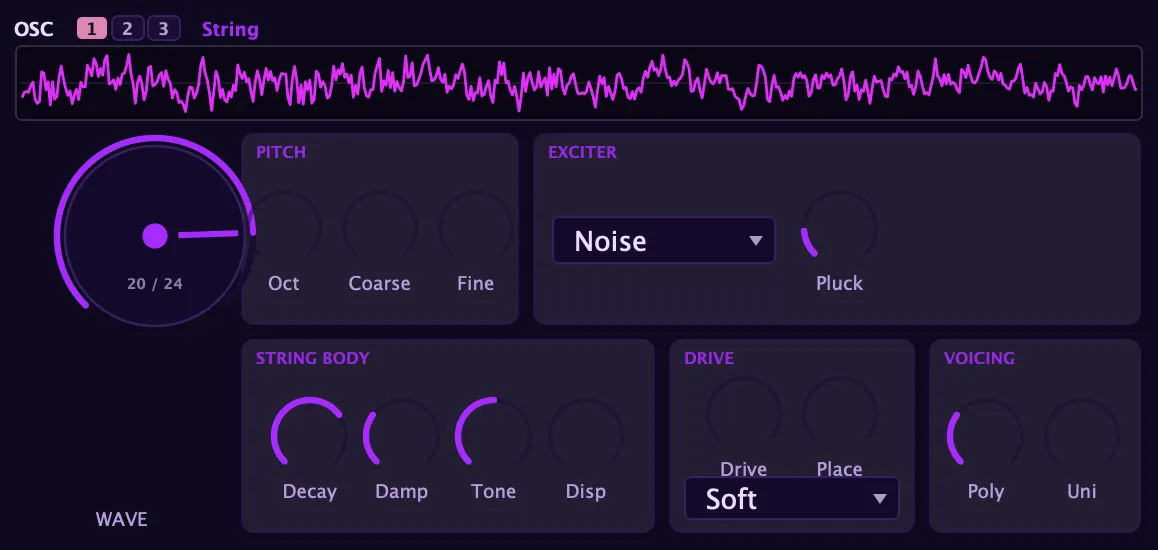
The String is a physical model of a vibrating string, not a wavetable or an analog oscillator playing back a fixed shape. Energy is fed into the string at note-on, and from there it rings and decays on its own, coloured by everything you do to it. From a single resonator it plays guitar, koto, harp, clav, a fully playable piano, and (with the Bow exciter) a singing violin, cello, or double bass. Two behaviours it shares with real strings: harder plucks are genuinely brighter, not just louder, and playing legato bends the still-ringing string rather than re-plucking it, so glides sound like a guitarist sliding a finger up the neck.
The String’s controls are laid out in labelled sections so the model reads like a real instrument rather than a wall of knobs. PITCH holds the octave, coarse, and fine tuning. EXCITER picks the front end that starts the string (below) and its one exciter-specific knob. STRING shapes the string itself: Decay, Damp, Tone, and Dispersion. BODY is a selectable soundboard that any exciter can drive. DRIVE is the string’s own saturation stage (Drive, Place, and a Drive Curve). VOICING carries the “realness” controls, Poly, Uni, and Humanize.
The Exciter: how the string is set in motion
Section titled “The Exciter: how the string is set in motion”The Exciter menu chooses the front end that starts the string, and it is the single biggest character control on the model. There are six, and they are all level-matched, so switching between them does not jump the output:
- Noise: a short burst of noise, the classic breathy Karplus-Strong pluck.
- Impulse: a short shaped click (not a lone spike), the brightest and most click-forward attack.
- From Osc: the oscillator’s own waveform seeds the string, for a harmonically rich, more synthetic pluck.
- Hammer: a velocity-sensitive felt-hammer strike whose attack sharpens the harder you play, which is exactly what makes a piano brighter when you hit it harder. This is the exciter that, with a Grand body behind it, turns the String into a playable piano.
- Bow: the one exciter that does not strike. Instead of seating energy once, it feeds a sustained friction force into the string for as long as you hold the key, so the string sings into a bowed violin, cello, or bass tone that rings while held and stops when you release. The same resonator that plays guitar and piano becomes a bowed-string instrument.
- Grand: a dedicated, purpose-voiced felt-hammer piano front end (a decorrelated three-string voice driving the grand soundboard). Where Hammer plus a Grand body builds a piano from the general parts, Grand is the fully-tuned piano exciter, the quickest route to the String’s playable grand tone.
The controls
Section titled “The controls”- Tone: pluck hardness, from a soft, round fingertip feel to a hard pick attack. Harder is brighter in timbre, not merely louder.
- Pluck Position: where along the string it is plucked, from a bridge-y, nasal quality to a round, full sound.
- Decay: overall ring time, from a short muted pluck to a long open sustain.
- Damping: how fast the highs fade relative to the low end, from dark and soft to bright and metallic.
- Dispersion: string stiffness, which stretches the overtones progressively sharp and morphs the timbre from guitar through koto and clav toward bell and piano. The fundamental stays in tune while the character changes underneath it. This is also the control behind the String’s piano behaviour: on a real piano the strings are stiff enough that their partials stretch measurably sharp, and more so the higher you play, which is why a piano’s top octaves are tuned deliberately sharp to match. Turn Dispersion up and the String reproduces that inharmonicity, the partials stretching sharp toward the treble exactly as a real piano’s do, which is a large part of why a Hammer-excited String reads as a genuine piano rather than a plucked synth.
- Drive and Place: Drive is a saturation stage that colours the string in a level-dependent way (loud passes fold over and grit up, then mellow as the note decays, for sitar and distorted electric-string tones). Place decides where that grit lives: at one end the saturation sits inside the string itself, so the character evolves over the note; at the other end it moves to the string’s output, like an amplifier placed after the pickup, for a cleaner and more aggressive edge. A single Drive Curve (Soft / Med / Hard) sets the fold hardness.
- Poly: dual polarisation. A real string vibrates in two planes at once, and those planes interfere into a two-stage decay and a gentle beating chorus, the single biggest “real versus synthetic” tell in a strung tone. Poly mixes in that second plane.
- Unison: true multi-string unison, the way a piano note is actually one, two, or three slightly detuned strings sharing one bridge. Off is a single string; turning it up brings in a second and then a third detuned string for the natural chorus and slow beating of a real strung note.
- Humanize: a small per-note scatter of pitch (up to about ±3 cents) and level (up to about ±2 dB), so repeated notes are never machine-gun identical the way a real player’s are not. At zero it is off and the model is exact; turn it up and the patch stops sounding sampled and starts to breathe. It is one of the biggest “alive versus static” tells on a repeated line.
- Bow Force and Bow Speed (Bow exciter only): the two live bowing controls. Bow Force is pressure and dynamics: harder bowing is louder, and pressing past the sweet spot over-presses into a raucous scratch. Bow Speed is brightness and articulation: a faster bow gives a brighter, quicker-catching tone. Route an envelope to Bow Force to swell a note up from silence, the signature bowed gesture.
The Body: a soundboard behind the string
Section titled “The Body: a soundboard behind the string”The Body selector is the string’s soundboard, and it is orthogonal to the exciter: it colours whatever the exciter feeds in, so you choose the front end and the body independently. This is what completes the physical model. A real piano is a hammer strike and a grand soundboard; a real acoustic guitar is a plucked string and a guitar body. Aconite models both halves and lets you pair them.
- Off: the bare string, no soundboard. Bit-exact; the model is exactly as it was.
- Guitar: the small, mid-forward body of an acoustic guitar. Pair it with a From-Osc or Noise pluck for a convincing acoustic guitar.
- Grand: a concert grand’s soundboard, with the open low bloom a big piano has. Pair it with the Hammer exciter and the String becomes a genuine piano: a real strike driving a real soundboard.
- Baby Grand: a smaller studio grand, similar density with a slightly higher bass floor.
- Upright: the boxier, bass-attenuated, mid-forward voice of an upright piano.
- Spinet: the thinnest of the pianos, weak in the bass and forward in the mids.
Because Body is independent of the exciter, you can drive any of these with any front end for combinations a single fixed instrument could never make: a bowed grand, a hammered guitar body, a From-Osc pluck through an upright.
With the Hammer exciter and a Grand (or any piano) body, the String is a fully playable felt piano: note-off engages a damper, the top of the keyboard rings on undamped the way a real piano’s high strings do, and the sustain pedal holds notes open. Every String control is a mod-matrix destination, so the whole string can breathe under an LFO, envelope, or the step sequencer.
Modal (struck and rung percussion)
Section titled “Modal (struck and rung percussion)”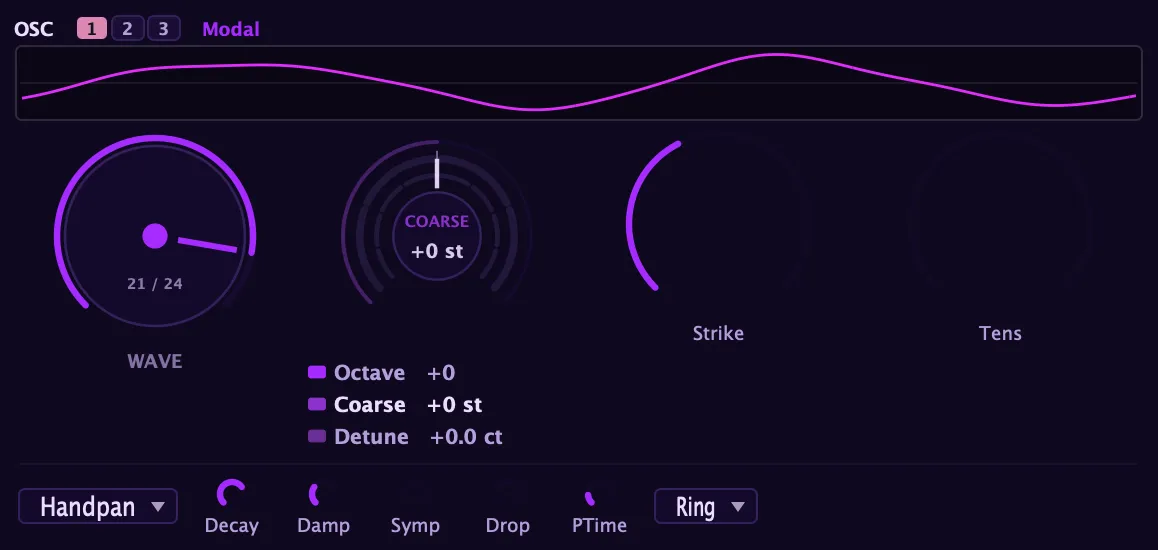
The Modal oscillator is the String’s sibling: instead of a string it is a bank of tuned resonant modes, struck at note-on. It covers a wide range of real struck-and-rung instruments from one voice, selected by the Modal Type menu:
- Membranes: Membrane, Timpani, Tabla, the skinned drums.
- Tuned metal: Steelpan, Handpan, the singing pitched-metal instruments.
- Struck bars: Marimba, Vibraphone, Xylophone, Glockenspiel.
- Bells: Tubular Bell, Church Bell.
- Idiophones: Woodblock, Cowbell, Glass Bowl.
Its controls shape the strike and the ring:
- Strike: where the instrument is struck, from the centre (bass, round) to the edge (bright, slappy).
- Tension: the tuned-metal “sing”. Struck hard, the partials of real tuned metal bend upward in pitch and the upper harmonics arrive slightly after the strike, the blooming shimmer of a bell or a handpan. Turn Tension up to add that bloom.
- Decay: overall ring time, from a short damped hit to a long singing sustain.
- Damp: how fast the high modes die relative to the low ones, from dull and muted to bright and ringing.
- Symp(athy): a halo of lightly damped neighbouring resonances ringing under the struck note, the played-together shimmer of a handpan or steelpan.
- PDrop and PTime: a pitch drop on the strike (the note starts sharp and glides down to pitch), which gives that struck-metal “bloom” and the boom of a kick or timpani. PDrop is the depth (0 is off), PTime the glide time from a fast snap to a slow settle.
A Ring / Choke selector sets the note-off behaviour: Ring lets the body decay on its own, and Choke mutes the tail when you release the key, for tight one-shot percussion. Re-striking a still-ringing Modal note layers on top of the ringing body rather than resetting it, exactly as real percussion does. The mode-shaping controls are mod-matrix destinations.
Kick (808-to-909 drum synth)
Section titled “Kick (808-to-909 drum synth)”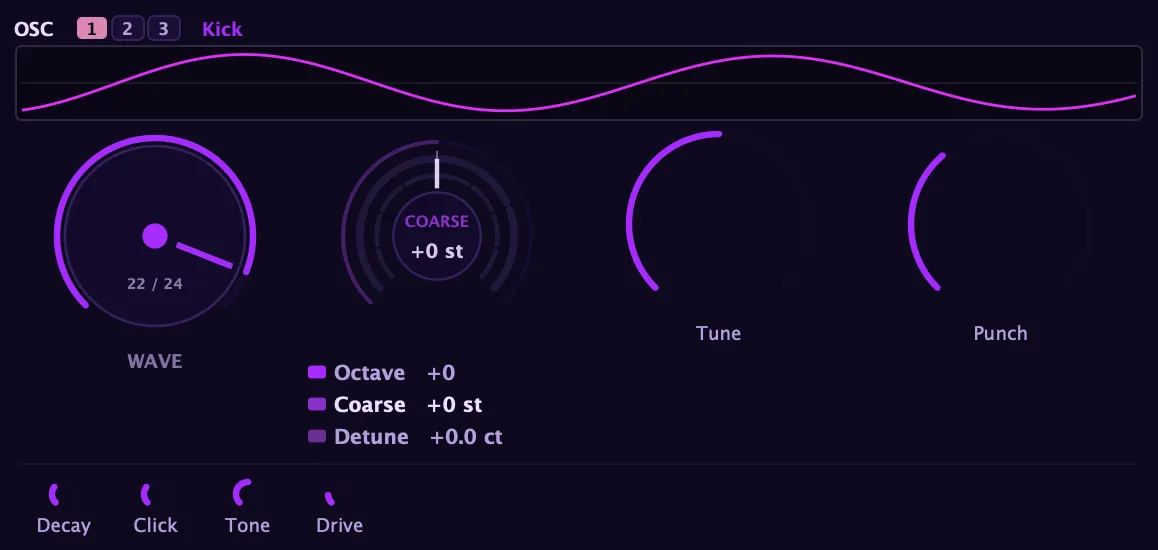
The Kick is the third of the struck family, a flexible bass-drum voice that sweeps continuously between a TR-808 character and a TR-909 character. One note-on is one kick, and like the String and Modal it plays through the voice’s filter, amp, and effects. There is no 808/909 switch; the six panel controls cover the whole range (use the standard Octave / Coarse / Detune knobs for overall pitch — the Kick tunes to the played note like any oscillator):
- Punch: the depth of the pitch snap. Near the bottom it is the 808’s subtle tick (around +1 octave); near the top it is a deep 909-style sweep (around +3 octaves).
- Snap: how fast that pitch snap falls, from an instant 808 snap (around 6 ms) to a slower 909 fall (around 120 ms). Snap is independent of Punch, so a deep snap can also be fast: the hard 909 attack that a single coupled knob could never reach.
- Decay: how long the body rings, from a short punchy thump (around 50 ms) to a long, sustained 808 boom (up to about 2.5 seconds).
- Click: the level of the beater-click attack (a short filtered noise burst). At zero it is bypassed and the body is a clean sine sub.
- Click Tone: the colour of that click, from a dark thud to a bright, snappy tap.
- Drive: a soft-clip on the whole body, from a clean sub at zero to 909-style grit and harmonics as you push it.
All six controls are mod-matrix destinations (plus a “Kick Tune” matrix destination that lets you automate a fine pitch offset even without a panel knob). Two factory presets anchor the range: 808 Bass (a sustained, tuned 808 sub-bass with a long decay, mono glide, and Drive saturation) and 909 Kick (a punchy house/techno kick with deep Punch, fast Snap, a short decay, a sharp click, and grit).
Lo-fi / vintage-digital character
Section titled “Lo-fi / vintage-digital character”Where the analog models warm and round the clean waveforms, the lo-fi stage does the opposite: it makes them cold, brittle, and unmistakably digital. This is the sound of early samplers and cheap hardware, PPG grit, 8- and 12-bit crunch, and the raw edge of a chiptune. Every oscillator that offers it starts clean, so the lo-fi character is something you dial in deliberately, not a colour you have to work around.
The controls live behind a LO-FI toggle on the oscillator, one click away so they stay out of your way until you want them. Flip it on and you get three knobs:
- Bits: bit-depth reduction. At the top it is perfectly clean. Turn it down and the waveform is quantised into progressively coarser steps, adding gritty, crunchy, vintage-digital distortion that gets harsher the lower you go.
- Crush: sample-rate reduction. It decimates the oscillator, holding each sampled value for a moment before it grabs the next, which brings in the cold, aliased character of cheap early digital hardware. A little roughens the tone; a lot turns it harsh and ringing.
- Alias: this defeats the oscillator’s built-in anti-aliasing. Normally Aconite keeps the harmonics clean; turn Alias up and the raw waveform’s upper harmonics fold back into the audible range as buzzy, inharmonic tones. This is the classic “naive digital oscillator” sound, gritty and slightly detuned in a way that is unmistakably early-digital.
All three are off by default, so a fresh oscillator is clean until you reach for them. They stack: a little Bits with a touch of Crush and Alias piles the vintage character up fast.
Lo-fi is offered on the clean-digital engines: the plain band-limited waveforms (Sine, Saw, Square, Triangle, and Shark’s-tooth) and the Wavetable oscillator. It is intentionally left off the analog-modelled, physical-model (String, Modal, Kick), and Additive oscillators, because crushing voices that already have a strong character of their own fights against what makes them distinctive. If you want to lo-fi one of those, or the whole patch at once, reach for the bit-crusher in the effects rack instead, which processes the full mix rather than a single oscillator.
Chip (two authentic chip families: NES 2A03 and C64 SID)
Section titled “Chip (two authentic chip families: NES 2A03 and C64 SID)”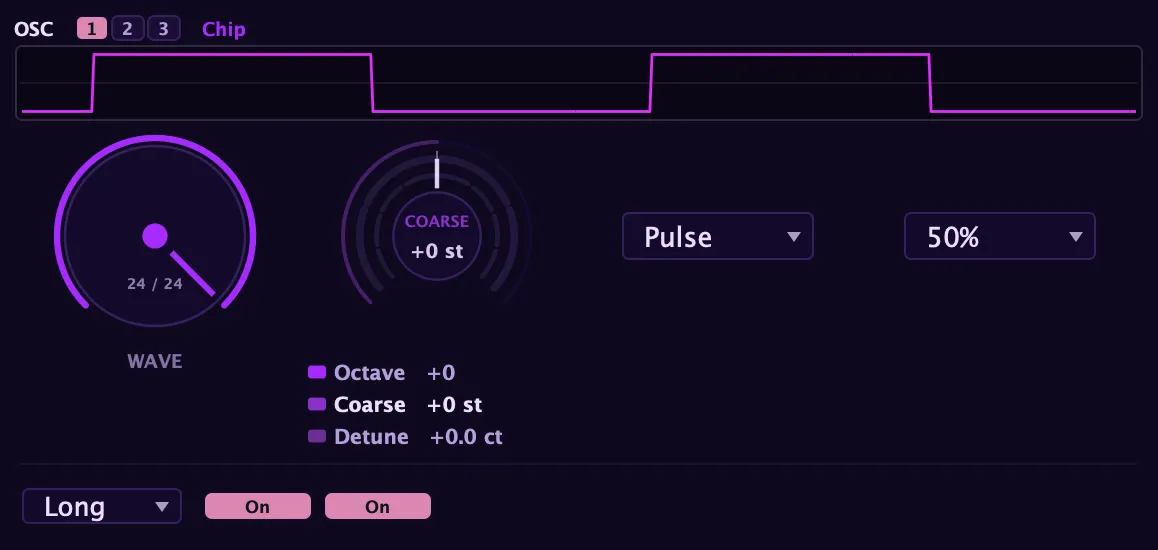
The Chip oscillator is a from-scratch model of real sound-chip hardware, not a bit-crushed modern oscillator dressed up to sound old, and not the same thing as the lo-fi stage above (which degrades a clean waveform). Chip is the chip: it behaves like the real silicon, stepped edges and all, so it reads as a genuine console voice.
A Family selector chooses which chip you are playing:
- NES 2A03: the Nintendo / Famicom sound chip, the Ricoh 2A03 (the default).
- SID 6581/8580: the Commodore 64’s MOS 6581 (and its later 8580 revision), the chip behind the C64’s unmistakable thick, buzzy character.
The Wave and Duty controls feed whichever family is active, so the panel stays the same shape while the voice underneath changes.
NES 2A03
Section titled “NES 2A03”A Wave menu picks one of the three classic 2A03 voices:
- Pulse: the pulse-wave voice, with the four hardware duty cycles, 12.5%, 25%, 50%, and 75%, chosen with the Duty menu. 50% is the plain square; the narrower duties are the thin, nasal, hollow tones that carry so many chiptune leads.
- Triangle: the stepped triangle, the rubbery NES bass and melody voice. The staircase steps are deliberately present, not smoothed away, because that gentle quantised stagger is part of the sound.
- Noise: the console’s noise channel, a metallic or hiss-like tone with a Noise Mode toggle. Long is a broad white hiss, good for snares and wind; Short is a much shorter, pitched, metallic buzz, good for zaps and percussive blips.
Two authenticity toggles, both on by default, are what make it read as “Nintendo”:
- Pitch Quant is the headline control. Real 2A03 hardware can only tune to a coarse grid of pitches, and because that grid gets coarser as notes rise, high notes on real hardware drift slightly, mechanically out of tune. Pitch Quant reproduces that exactly: it snaps the played pitch onto the console’s tuning grid, so the top of the keyboard has that unmistakable, slightly-off console intonation. Leave it on for the authentic sound; turn it off when you want the chip timbre with clean, exact tuning.
- A 4-bit output quantize snaps the level onto the coarse 16-step amplitude grid the real chip uses, another part of its gritty character.
Every Chip setting is per oscillator, so the three oscillators act as three independent console channels. You can build a whole NES arrangement inside a single patch: two pulses at different duty widths for a lead and a harmony, the triangle for bass, and the noise channel for percussion, each with its own Wave, Duty, and pitch.
SID 6581/8580
Section titled “SID 6581/8580”Switch Family to SID and the Chip oscillator becomes the Commodore 64’s MOS SID, modelled the same from-scratch way: 12-bit phase-accumulator waveforms fed through the chip’s own DAC, so its thin, nasal, glassy-yet-gritty voice comes from the silicon rather than a filter dropped on a modern oscillator.
- Waveforms: Saw, Triangle, Pulse (with the SID’s continuous 12-bit pulse width), and the LFSR Noise channel. These are the four voices behind countless C64 tunes.
- Combined waveforms: on a real SID, asking for more than one waveform at once did not simply mix them, it bit-ANDed them into the strange, thin, half-there combined tones that are a signature part of the chip’s sound. The model reproduces that quirk rather than crossfading, so those glassy combined voices are available exactly as they were on the hardware.
- Ring mod and sync: the SID’s triangle ring modulation and hard sync give it its metallic, clangorous edge, part of what made SID leads cut the way they did.
- 6581 vs 8580 revision: a Rev toggle picks between the two chips Commodore shipped. The 6581 (default) has the famous non-monotonic DAC that adds per-sample grit to every waveform and dirties the combined tones, the warm, gritty “classic SID”. The 8580 is the cleaner later revision, with a near-ideal DAC and tidier combined waves. It is the single biggest character control on the SID voice.
Tuning
Section titled “Tuning”Each oscillator has three pitch controls that stack:
- Octave: shifts by octaves from −4 to +4. Use this to put two oscillators at very different registers or to stack sub and super-octave layers from a single patch.
- Coarse: up to ±24 semitones. Useful for intervals (a fifth, a third, an octave plus a semitone) and for hard-sync sweeping.
- Detune: up to ±50 cents. Small amounts give natural beating between oscillators; larger amounts give wide, chorused stacks.
Per-voice analog drift (governed by Aconite’s aliveness layer, see The Aconite philosophy) adds a small, slow wander to each voice’s tuning independently, so a stacked chord shimmers rather than sitting perfectly still.
Pulse width and PWM
Section titled “Pulse width and PWM”Pulse width acts on the Square wave, the Saw (DCO) model (where it shapes the DCO’s built-in pulse source), and the Wavetable model (where it controls morph position instead):
- Pulse Width: the base duty cycle. At 50% you get the classic hollow square. Narrow it toward 0% or 100% and the tone thins into a sharp, reedy buzz.
- PWM Depth: how far an internal LFO sweeps the pulse width around that base value. Even modest PWM depth puts the oscillator in constant motion, adding an organic, breathed quality.
Each oscillator has its own independent pulse width, so you can set three different duty cycles and sweep them at three different depths simultaneously.
Note-on phase
Section titled “Note-on phase”Phase controls decide where the waveform starts when you press a key:
- Start Phase: the angle (0–360°) at which the waveform begins on each note-on. Moving this changes the attack transient, sometimes subtly, sometimes dramatically (especially on complex patches).
- Rand: adds a random per-note offset to the start phase, spreading voices apart from one another for a thicker, more analog-feeling attack.
- Retrig / Free: in Free mode, the oscillator continues wherever it was in its cycle when the previous note ended. In Retrig mode it resets to Start Phase on every note-on. Free is closer to how real analog oscillators behave; Retrig gives a more consistent, punchy attack transient.